
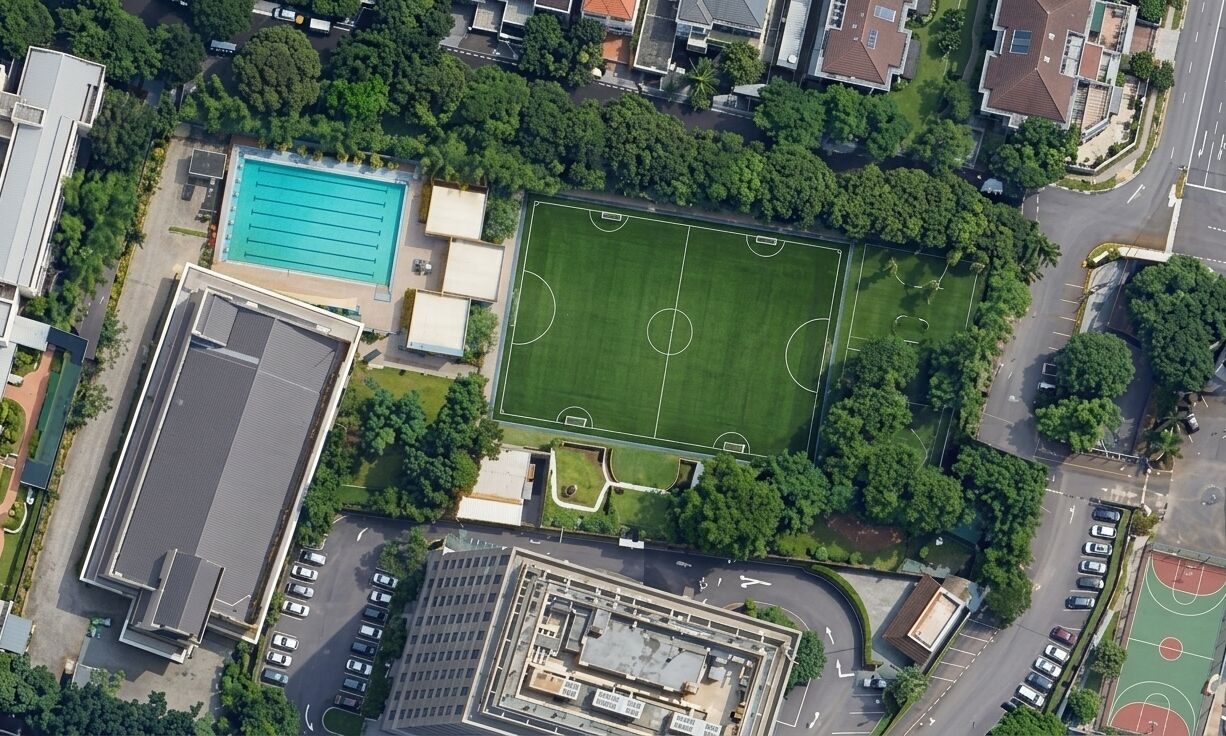
Pondok Indah and the wider South Jakarta corridor are the densest concentration of affluent, dual-income, internationally minded families in Indonesia. For this group, the headline public health figures are misleading. Most families read about hypertension and obesity prevalence and assume it is a problem for a different demographic. The data shows the opposite. Cardiometabolic risk in urban, sedentary, high-income Jakarta is at least as high as the national average, the air quality penalty is higher for those who spend the most time on Pondok Indah's main roads, and the child sedentary numbers are the part of the picture most ISJ parents underestimate.
This briefing pulls together what the academic literature, government surveys and 2024 to 2025 industry data say specifically for families living in Pondok Indah, Kemang, Senopati, SCBD and the surrounding South Jakarta neighbourhoods. The intent is practical: which risks are real, where the leverage points are, and what the local fitness, sport and screening ecosystem can do for a family that uses it well.

The wealthy Jakarta paradox
Affluence in Jakarta correlates with several risk factors at once. Office work is more sedentary. Door-to-door driving replaces incidental walking. Eating out is more frequent. Restaurant portions and Western dining cultures push calorie intake up. Helpers handle physical household tasks. Holidays often involve more eating than moving. The result is that South Jakarta households can carry a heavier cardiometabolic load than national averages suggest.
| Indicator | National (Riskesdas) | Urban Jakarta-specific finding |
|---|---|---|
| Adult hypertension | 34.1% (2018) | DKI Jakarta sits above the national average |
| Adult diabetes | 10.9% (2018) | Urban prevalence runs higher than rural |
| Overweight or obesity (BMI Asian cut-offs) | 21.8% (Riskesdas headline) | 67% in a Jakarta young-adult sample (IJMAES) |
| Adolescent obesity (Jakarta) | 4.2% (2013) → 8.3% (2018) | Roughly doubled in five years |
The practical implication for Pondok Indah families is that the screening cadence used in many Western countries, where a first comprehensive check happens in the late forties, is too late for urban Jakarta. A reasonable position, consistent with the panels RS Pondok Indah and RS Pondok Indah Puri Indah build into their executive packages, is annual lipid, HbA1c, blood pressure and body composition checks from the mid-thirties, earlier if there is a family history.
Air quality, told as a daily decision
Headline air quality figures are well known. Jakarta's 2024 mean PM2.5 was 41.7 micrograms per cubic metre, 8.3 times the WHO annual guideline. What is more useful for families is how this varies through the day and what to do with that information. PM2.5 in Pondok Indah follows a predictable pattern driven by the traffic on Jalan Metro Pondok Indah, TB Simatupang and the Pondok Indah Mall corridors.
| Window | Typical air quality | Suggested use |
|---|---|---|
| 4am to 7am | Cleanest window of the day. Traffic minimal, atmospheric mixing low. | Outdoor running, walking, golf, tennis, school PE prep. |
| 7am to 9am | Rush hour. PM2.5 rises sharply along main roads. | School run by car, indoor exercise only. |
| 9am to 4pm | Variable. Heat and humidity become the constraint. | Indoor studios, pool, shaded play. |
| 4pm to 7pm | Rush hour returns. Heat eases, PM2.5 rises near traffic. | Indoor sport, kids' classes inside clubs and schools. |
| After 9pm | Air clears as traffic thins. | Late run, dog walk, padel under lights at residential clubs. |
Two thresholds matter for daily decisions. If hourly PM2.5 exceeds 25 micrograms per cubic metre, sensitive individuals, including young children, should avoid outdoor exercise. If it exceeds 50, the general public should reduce outdoor activity and consider moving indoors. Most Pondok Indah families find that the IQAir, Plume or BMKG apps, set to alert on those numbers, are the simplest way to plan a week.
The children's picture
For ISJ families the most important section of the data is the one most often glossed over. Indonesia's national child activity numbers describe the environment your children are growing up in, and the indicators are sliding in the wrong direction.
- 57 percent of Indonesian children are insufficiently active.
- Over 70 percent show sedentary behaviour.
- 83.2 percent of school-day wear time among female adolescents is spent in screen-based sedentary activity. On non-school days the figure is 75.7 percent.
- 73.5 percent of Jakarta high school students exercise three or fewer days a week.
- Jakarta adolescent obesity doubled from 4.2 percent to 8.3 percent between 2013 and 2018.
For an internationally minded household, the structural risk is that a child grows up in an air-conditioned car, an air-conditioned classroom, an air-conditioned house and an air-conditioned mall, with most movement scheduled rather than incidental. Pondok Indah families are typically aware of this and overcorrect with a packed activity schedule. The evidence suggests two things are more important than volume of activity.
- Daily incidental movement. Walking from a parking spot, taking the stairs, kicking a ball in the garden, swimming before school. The cumulative minutes matter more than any single class.
- One sport the child chooses. Sustained adherence to one activity the child enjoys outperforms a rotating timetable of activities the parent has chosen.
Heat and humidity are part of the calculation
Jakarta's apparent temperature regularly exceeds 33 degrees Celsius with relative humidity above 75 percent. For children, the combined heat and humidity load is a more immediate physiological constraint than aerobic intensity. Hydration, shaded outdoor time and avoiding hard exercise in the 11am to 3pm window are the simple rules most school PE departments already follow. Families running their own weekend activity plans benefit from doing the same.
The fitness boom, mapped to your neighbourhood
Indonesia's health and fitness market grew 6.1 percent in 2024, and South Jakarta is the densest expression of that growth. Several formats have reached cluster density in Pondok Indah, Kemang, Senopati, SCBD and the Senayan strip, which makes consistent attendance realistic for the first time.
| Format | Who it suits | What the data shows |
|---|---|---|
| Reformer pilates | Adults seeking low-impact strength and postural work; popular with mothers and post-natal recovery. | Pilates sessions tracked on Garmin up 42% year on year. Pondok Indah and Senopati host the densest studio cluster in Indonesia. |
| Padel | Couples, families with teens, social adult players. Lower joint load than tennis. | South Jakarta leads Indonesia with 61 new clubs in 2025. Court revenue rose from €2,300 to €6,300 per month between 2023 and 2024. |
| HIIT and group strength | Time-poor professionals; 45 to 60 minute sessions before or after work. | HIIT sessions up 56% year on year. Strength training up 25%. |
| Run clubs and marathons | Adults wanting community alongside training; weekend pacing groups. | Jakarta International Marathon doubled from 15,000 to 30,000 runners between 2024 and 2025. |
| Boutique gyms and personal training | High-income adults wanting privacy, one-to-one programming and longevity-style protocols. | Premium membership commonly IDR 2 to 5 million per month plus PT fees. |
| Golf, tennis, swimming | Families using residential club memberships at Pondok Indah Golf, Senayan and the international embassy clubs. | Cluster of outdoor sport options inside protected, lower-traffic environments. |
Why Pondok Indah specifically
Pondok Indah is unusual within Jakarta. Household income is high. Density is lower than the central business districts. Streets inside the residential blocks are quieter than the main TB Simatupang corridor. The neighbourhood contains the country's most prominent private hospital complex in RS Pondok Indah, with sister sites at Puri Indah and Bintaro Jaya. Most international school families also live within fifteen to twenty minutes of either Pondok Indah Golf, Senayan, the embassy clubs or the SCBD studios. Four practical consequences follow.
- Premium boutique fitness is commercially viable at scale. Reformer pilates, padel memberships in the IDR 2 to 5 million per month range and one-to-one personal training all support local supply that would not survive in less affluent districts.
- Clinical screening is normalised earlier in life. Executive health check-ups at RS Pondok Indah, SOS Medika, Mayapada and Siloam are widely used by Pondok Indah families from their mid-thirties, well before the typical Indonesian age at first diagnosis.
- Residential clubs preserve outdoor sport. Pondok Indah Golf, the Mercantile Athletic Club, the American Club, the British International Club and the Jakarta Executive Club provide tennis, swimming, golf and running in lower-traffic, lower-particulate environments than the main roads.
- Helpers are part of the fitness infrastructure. Live-in support enables the early-morning exercise window that the air quality data rewards. Most families who exercise consistently do so before the school run, which is only possible if breakfast and uniforms are covered.
An evidence-led weekly model
The literature consistently identifies consistency, not volume, as the differentiator. Drawing on the activity, air quality and screening data, the following week is what a typical research-aligned schedule looks like for a dual-career household with school-age children.
| Slot | Adults | Children |
|---|---|---|
| 5.30am to 6.30am, weekdays | Outdoor run or walk inside the residential block; alternate with reformer pilates two days a week. | Optional swim or garden movement before breakfast. |
| School day | Step counter target 8,000 to 10,000; one walking meeting if office-based. | PE, recess and after-school sport at school. ISJ families benefit from sport built into the school day. |
| 4pm to 6pm, twice a week | Strength or HIIT session in an air-conditioned studio. | One chosen extracurricular sport (swimming, football, tennis, gymnastics). |
| Saturday morning | Padel, golf, run club or long walk before 9am. | Family sport: swimming, cycling, padel for older children. |
| Sunday | One easy active hour. Car Free Day on Jalan Sudirman remains the best outdoor weekly anchor. | Outdoor play in lower-traffic areas, ideally before 9am. |
| Annually | Executive MCU from the mid-thirties: lipids, HbA1c, blood pressure, body composition, plus cardiac screen on indication. | Annual paediatric review with growth tracking, vision and posture; vaccination check. |
What the evidence says, in five points
- Affluence is a risk factor, not protection. Sedentary office work, door-to-door driving and frequent eating out all raise cardiometabolic risk in the South Jakarta professional cohort.
- Outdoor exercise has a narrow clean window. Early morning, before 7am, and late evening, after 9pm, are the only windows where PM2.5 is reliably within sensitive-group thresholds.
- Children's sedentary behaviour is the bigger long-term issue. An 83 percent screen-based sedentary share on school days compounds over years. School PE alone is not enough.
- The supply side is solved. Pondok Indah, Kemang, Senopati and SCBD have reached cluster density on pilates, padel, run clubs, premium gyms and golf. Consistency is now a calendar problem, not an access problem.
- The hospital ecosystem is the screening anchor. Pondok Indah families using annual executive MCUs from the mid-thirties pick up most cardiometabolic risk early, when lifestyle changes are still highly effective.
Sport and movement at ISJ
ISJ sits in the middle of the Pondok Indah ecosystem described above. Daily PE, swimming, sport and outdoor learning are built into the school week, the campus is within a short drive of the studios, courts and clubs most families use, and ISJ's pastoral team is familiar with the air quality, heat and screen-time pressures that South Jakarta children grow up with. The evidence on physical activity and academic attainment, the Jakarta healthcare briefing and the quality of life guide are useful companions. ISJ's admissions team can talk through the practical side, including which clubs and studios local families use.
Further reading
- The Impact of Lifestyle Changes on Prediabetes and Diabetes in Urban and Rural Indonesia (Riskesdas 2013 and 2018)
- Hypertension Among Young Adults in Indonesia, Analysis of Riskesdas 2018
- Body Mass Index and Fitness Level of Jakarta's Young Adults (IJMAES)
- Sedentary Behavior and Lack of Physical Activity among Children in Indonesia (PMC)
- Physical Activity and Sedentary Behaviour of Female Adolescents in Indonesia (PMC)
- Indonesia Report Card on Physical Activity for Children 2022
- Snacking, Eating Habits, Physical Activity and Obesity among Jakarta High School Students (PMC)
- Jakarta Among Top 10 Most Polluted Cities (IQAir, August 2025)
- Impacts of Air Pollution on Health and Cost of Illness in Jakarta (PMC)
- Hidden Dangers of Outdoor Exercise, PM2.5 and Ozone (Asian Institute of Technology, 2025)
- Indonesia's Health and Fitness Industry: Trends, Growth, Opportunities (The Shiv)
- From Padel to Pilates: Indonesia's Next Consumer Wave (Vertex Ventures SEA)
- Padel Courts Rise in Jakarta to Meet Surging Demand (Jakarta Post, 2025)
- South Jakarta: The City with the Most Padel Court Sales in 2025 (Databoks)
- RS Pondok Indah, Executive Health Check-Up